Full text available in English
The fifteenth of March
On the Ides of March — the fifteenth — in 44 BC, a group of Roman senators surrounded Gaius Julius Caesar in a hall attached to the Theatre of Pompey and stabbed him to death. The man history remembers as the leader of that conspiracy was Marcus Junius Brutus, a senator who traced his family, truly or not, to the Brutus who had expelled Rome's last king four and a half centuries earlier.
The assassins called themselves liberators. Within two years they were dead, their cause lost at Philippi, and the Republic they claimed to defend was gone forever — replaced by the very thing they feared: the rule of one man.
Between the murder and the ruin, Brutus did something that no amount of political failure could erase. He put the assassination on money.
A monument the size of a coin
Coins in the Roman world were not merely economic instruments. They were the closest thing the ancient Mediterranean had to mass media — small metal broadsheets carried in every purse from Spain to Syria. Brutus, campaigning in the East and needing to pay his troops, struck coins. And on one of them, a silver denarius, he issued a design of astonishing directness.
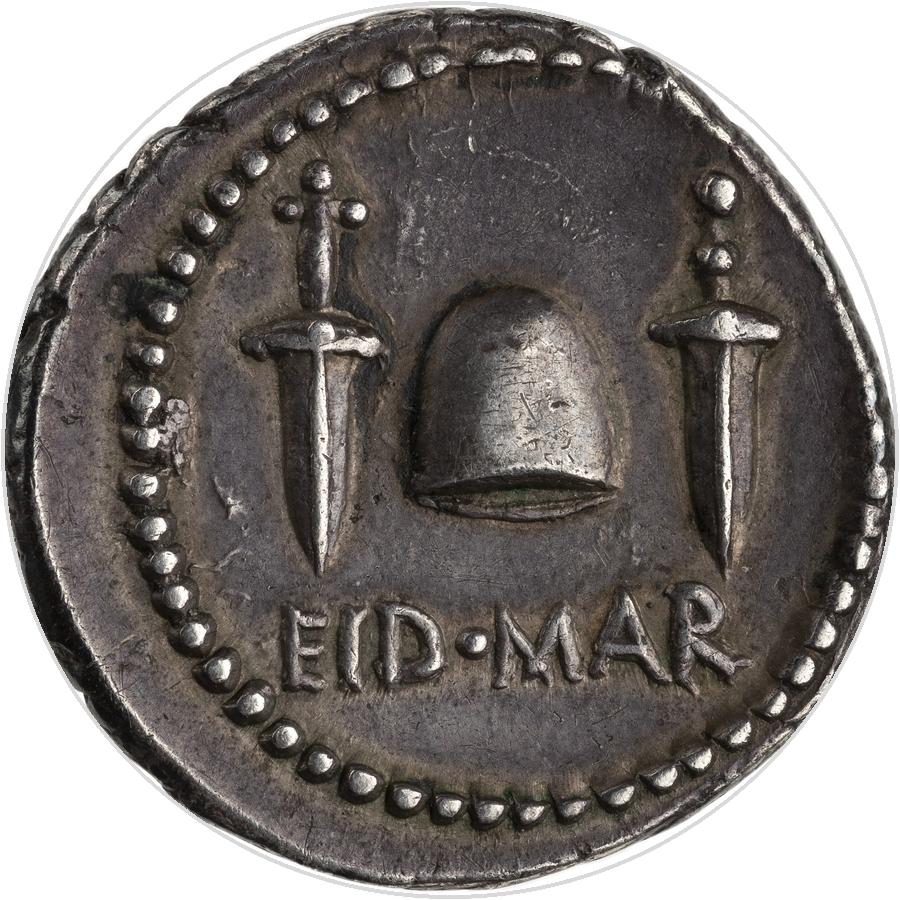
The reverse shows two daggers flanking a pileus — the soft felt cap given to freed slaves as the emblem of liberty — and beneath them two words: EID·MAR, Eidibus Martiis, “on the Ides of March.”
It is difficult, across two thousand years, to feel how brazen this was. The coin does not allude to the killing. It dates it, names it by its instrument, and declares its purpose in a single breath. Here are the daggers. Here is liberty. Here is the day.
There is no ancient equivalent. No other coin of the classical world so plainly commemorates a specific act of political violence committed by the very man who issued it. It was so remarkable that it drew comment from the historian Cassius Dio more than two centuries later, who described its imagery with a precision that tells us he, or his source, had actually held one. Coins simply did not get written about that way. This one did.
“Brutus stamped upon the coins which were being minted his own likeness and a cap and two daggers, indicating by this and by the inscription that he and Cassius had liberated the fatherland.”Cassius Dio, Roman History XLVII.25
The face of a living man
The reverse is the coin's argument. The obverse is its scandal.
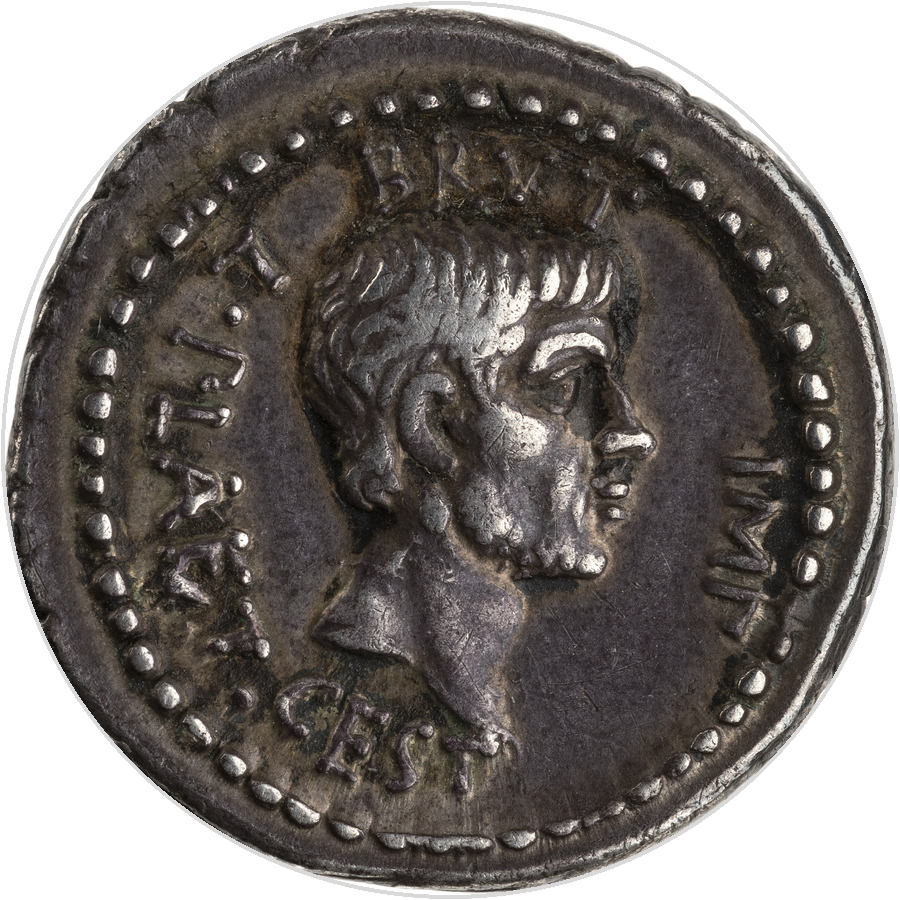
There, in profile, is the bearded head of Brutus himself, ringed by the legend BRVT IMP — Brutus, Imperator — and the name of the officer responsible for the issue, L·PLAET·CEST, Lucius Plaetorius Cestianus. To modern eyes a portrait on a coin is unremarkable. To a Roman of 42 BC it was very nearly the whole problem.
Under the Republic it was taboo for any living Roman to place his own likeness on the coinage. Portraiture was the visual grammar of kingship, and Rome had defined itself for four and a half centuries against kings. When Caesar became the first living Roman to put his own face on coins struck at Rome, in early 44 BC, it was widely read as confirmation of exactly the regal ambition that would get him killed weeks later.
And so the irony sits at the centre of this coin, and no ancient viewer could have missed it: Brutus, having helped murder a man in part for putting his face on money, promptly put his own face on money. Scholars who have studied the portraits from the art-historical side call the EID MAR likeness the soberest and most precise of all his coin portraits — a realistic, unsparing face, as though the die-engraver understood that this particular man could not be seen to flatter himself.
What it was worth, and who got the gold
Strip away the history and the EID MAR was, at issue, a soldier's wage. A denarius was a day's pay for a labourer and a few days' pay for a legionary. Brutus struck these coins in a military mint that travelled with him through northern Greece and Asia Minor, in the anxious months before Philippi, precisely because an army marches on silver. Most of the men who first handled one were not collectors or senators. They were soldiers being paid to fight a civil war, holding a small silver disc that told them, in two words, why.
That ordinary origin makes the survivors extraordinary. Coins struck to be spent were spent, worn, lost — and melted. When Brutus lost, his money became the losing side's propaganda, and the victors had every reason to pull it from circulation and recoin it. The EID MAR is rare today in large part because it was made rare, deliberately, by the men who defeated the man who struck it.
A handful were struck not in silver but in gold, as aurei, worth perhaps twenty-five denarii each. Gold was not soldiers' pay. Gold, in this context, was almost certainly for the men at the top — senior officers, allied client-kings whose loyalty had to be purchased, the inner circle of the conspiracy. An EID MAR aureus was a political object from the moment it left the die. Three are known to exist today, and none of them can be bought.
The motif that outlived the Republic
The design proved impossible to forget. The daggers-and-cap reverse reappears on an anonymous Roman denarius of AD 68, struck to agitate against Nero; on a Renaissance medal of 1537 celebrating the murder of Alessandro de’ Medici by a man styling himself a new Brutus; on a French medal of 1552; and on a Swiss civic medal from 1742. Seventeen centuries of borrowed menace, all tracing back to one small coin struck in a field camp by a losing general.